
Guilford County Criminal Court Records
A criminal court record is the case-level file kept by the Clerk of Superior Court after a criminal matter is opened in the North Carolina court system. It can include the charging instrument, case number, defendant name, hearings, pleas, motions, orders, disposition, sentence, fines, costs, probation, and appeal activity. The record follows the case, not just the arrest. A person may be arrested by law enforcement, booked at a detention center, and later have formal court charges filed and tracked through the court record.
Guilford County is Prosecutorial District 24, Superior Court District 24, and District Court District 24. Superior Court handles felony criminal cases, civil cases over $25,000, and misdemeanor or infraction appeals from District Court. District Court handles misdemeanors, infractions, and magistrate matters. Magistrates, as officers of District Court, issue arrest warrants, conduct initial appearances, and set conditions of release. For charge-focused booking and arrest material, use the separate Guilford County arrest records and court charges route.
The North Carolina Judicial Branch criminal case help source is shown in this official image.
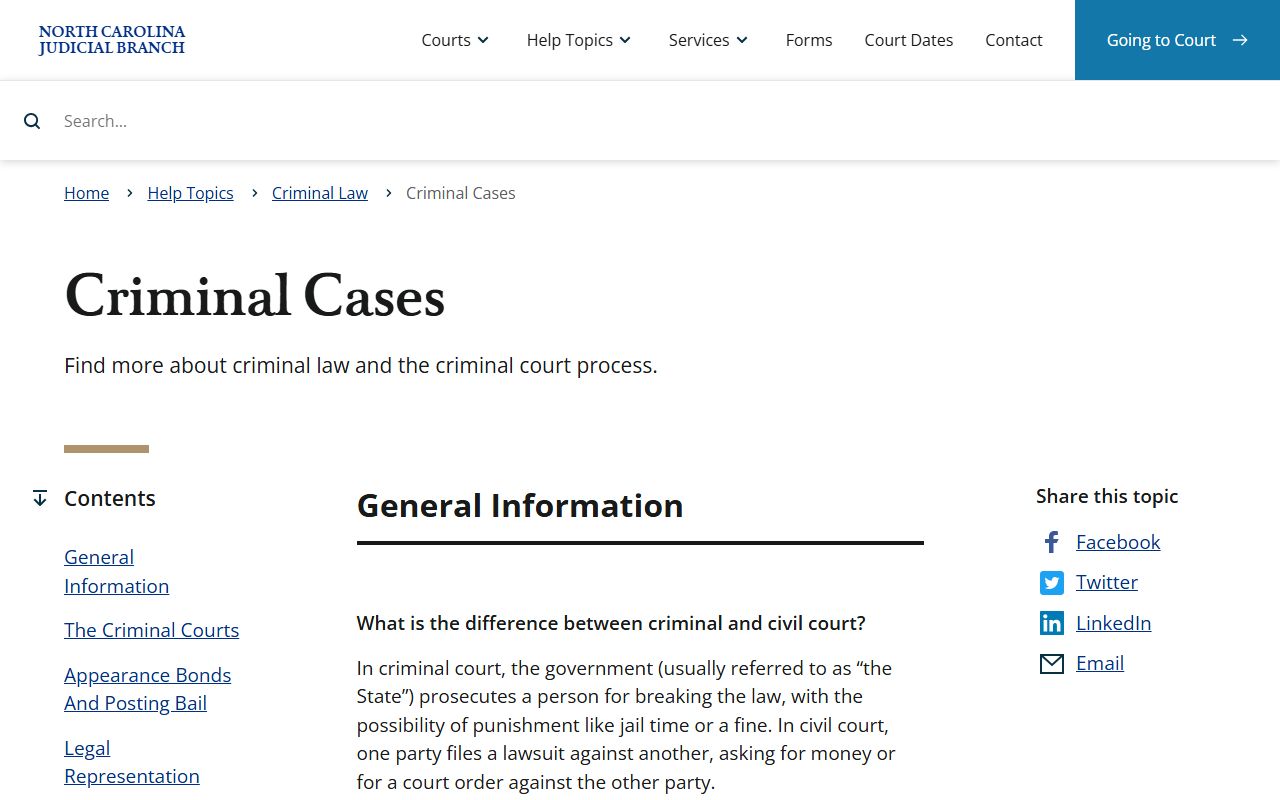
That state source explains core criminal case terms that appear in Guilford County criminal court records, including offense levels and case-number clues.
Search Guilford County Criminal Court Records
Public online criminal case information starts with the North Carolina eCourts Portal. Smart Search can locate public case summaries by case number, defendant name, business name, date filters, and location filters. Search Hearings is the companion tool for court dates. Portal access is useful for a first look at criminal court records, but the Judicial Branch warns that people performing background checks should use the county clerk's office instead of relying on Portal alone.
- Open the North Carolina eCourts Portal and use Smart Search for public case information.
- Search by defendant name or case number, then narrow the location to Guilford County when needed.
- Review the case summary for charges, court events, hearings, disposition, sentence, and financial items.
- Use Search Hearings if the immediate need is a court date or courtroom setting.
- Request a certified single-county criminal record search from the Clerk of Superior Court when certification is required.
The certified single-county criminal record search uses AOC-CR-314 through the clerk and costs $25. Clerk public terminals can also search criminal information by defendant name, case number, or victim and witness name. Paper files, certified copies, and files not fully available online still route to the Clerk of Superior Court in Greensboro or High Point.
Guilford County Criminal Case Stages
Criminal court records are easiest to read as a sequence. The first entries may relate to a warrant, citation, arrest, or initial appearance. As the case moves forward, the court record can show arraignment, pretrial motions, plea negotiations, hearings, trial settings, verdict, disposition, and sentence. Not every case has every stage. A misdemeanor may resolve in District Court, while a felony normally proceeds in Superior Court.
Case flow: Charges Filed › Arraignment › Pretrial / Motions › Plea or Trial › Disposition › Sentencing
| Stage | What Happens |
|---|---|
| Charges Filed | The accusation enters the court record by warrant, citation, indictment, or other charging document. |
| Arraignment | The court addresses the charge and plea. The record may show plea status or counsel information. |
| Pretrial / Motions | The docket may show continuances, motions, discovery issues, bond matters, or calendar settings. |
| Plea or Trial | The case resolves by plea, trial verdict, dismissal, or another court action. |
| Sentencing | If there is a conviction, the record may show sentence, probation, fines, costs, and related orders. |
What Guilford County Criminal Records Show
North Carolina case numbers carry useful information. The Judicial Branch criminal case guidance says case numbers begin with the last two digits of the year charged. If the next two characters are CR, the case includes at least one criminal offense. If the next two characters are IF, the case is infraction-only. A person can have both criminal and infraction charges connected to the same incident or multiple case numbers tied to one event.
| Field | What It Shows |
|---|---|
| Case Number | The court identifier, including year and case-type clues such as CR or IF. |
| Defendant | The person charged in the criminal case, with other identifiers only if public. |
| Charges | The alleged offenses, statute references, severity, and charge status where shown. |
| Hearings | Court dates, hearing types, courtroom or judicial officer details when available. |
| Plea | The defendant's response to charges, such as guilty, not guilty, or another plea entry. |
| Disposition | The outcome of each charge or case, including guilty, not guilty, dismissed, or other result. |
| Sentence | Punishment after conviction, such as probation, custody, fines, costs, or other court orders. |
Guilford County Criminal Courts
Criminal court records in Guilford County split by case level. District Court handles most misdemeanors and infractions, plus magistrate matters such as initial appearances and bond. Superior Court handles felonies and appeals from District Court misdemeanor or infraction convictions. District Court criminal trials are non-jury. A misdemeanor conviction in District Court can be appealed to Superior Court for a new trial.
The official Superior Court source is shown below.
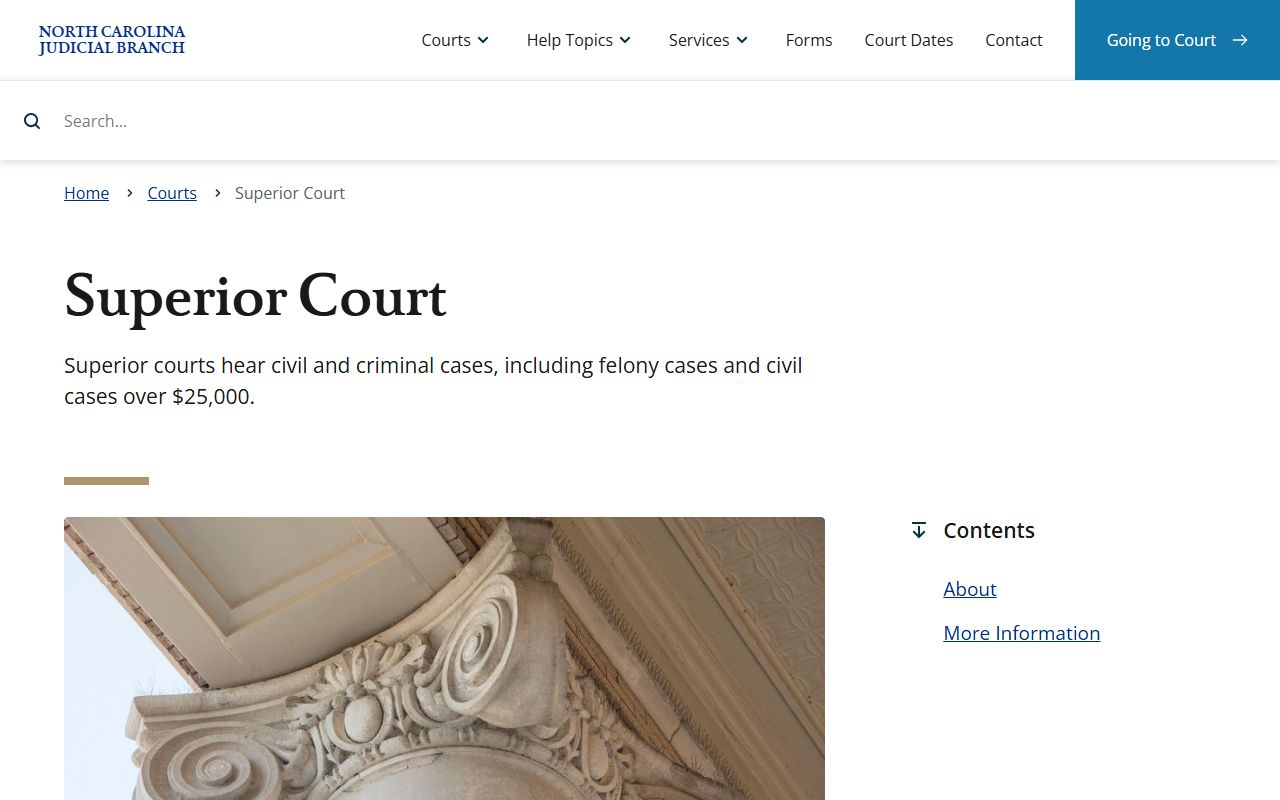
Superior Court jurisdiction is important for Guilford County felony records because the full criminal case file may move beyond the early magistrate and District Court stages.
| Court Level | Criminal Role | Record Clue |
|---|---|---|
| District Court | Misdemeanors, infractions, initial appearances, and magistrate-linked matters. | May show non-jury misdemeanor proceedings and infraction cases. |
| Superior Court | Felonies and appeals from District Court misdemeanor or infraction convictions. | May show indictments, felony pleas, felony trials, and sentencing. |
| Magistrates | Warrants, bond, and first appearance work as District Court officers. | Early record entries may point to warrants, bond, or initial release conditions. |
Criminal Charges vs Convictions
Being charged is not the same as being convicted. A Guilford County criminal court record can show charges that are pending, amended, reduced, dismissed, or resolved by plea or verdict. The case file should be read by charge, not only by case number, because one case may include several counts with different outcomes. A dismissal or acquittal should not be described as a conviction.
| Charge | Conviction | |
|---|---|---|
| Meaning | An accusation filed in court. | A guilty plea, guilty finding, or verdict of guilt. |
| Timing | Appears near the start of the case. | Appears after plea, trial, or other final action. |
| Record Reading | Check status and disposition for each count. | Check sentence, probation, fines, costs, and appeal activity. |
Read Guilford County Dispositions
A disposition is the outcome of a charge or case. Common outcomes include guilty, not guilty, dismissed, and other court-specific entries. A sentence is different from a disposition. The disposition says how the charge ended. The sentence says what punishment or condition followed a conviction. Financial information may show fines, costs, probation fees, or other money items when public.
Do not read one docket event as the final result unless the disposition is clear. A hearing entry may be a calendar event, continuance, motion setting, or plea setting. For formal use, request certified copies or a certified criminal record search from the Clerk of Superior Court. For custody status, use the jail roster rather than the criminal court record.
Note: Portal case summaries are useful for review, but certified criminal searches come from the clerk.
Sealed vs Expunged Criminal Records
Restricted criminal court records require careful wording. Juvenile delinquency and undisciplined records are restricted under Chapter 7B. Expunged records are confidential under G.S. 15A-151. Law enforcement investigative records are also limited under G.S. 132-1.4 and are not the same as filed court records.
| Sealed or Restricted | Expunged | |
|---|---|---|
| Public View | Hidden or limited by statute, court order, or case type. | Removed from ordinary public access and kept as confidential clerk material. |
| Examples | Juvenile matters, some sensitive filings, and records restricted by order. | Eligible arrest, charge, or conviction records after an expunction order. |
| Access Route | Usually party status, statute, or court order. | Confidential access only as allowed by law. |
The expunged-record confidentiality source appears in this official statute image.
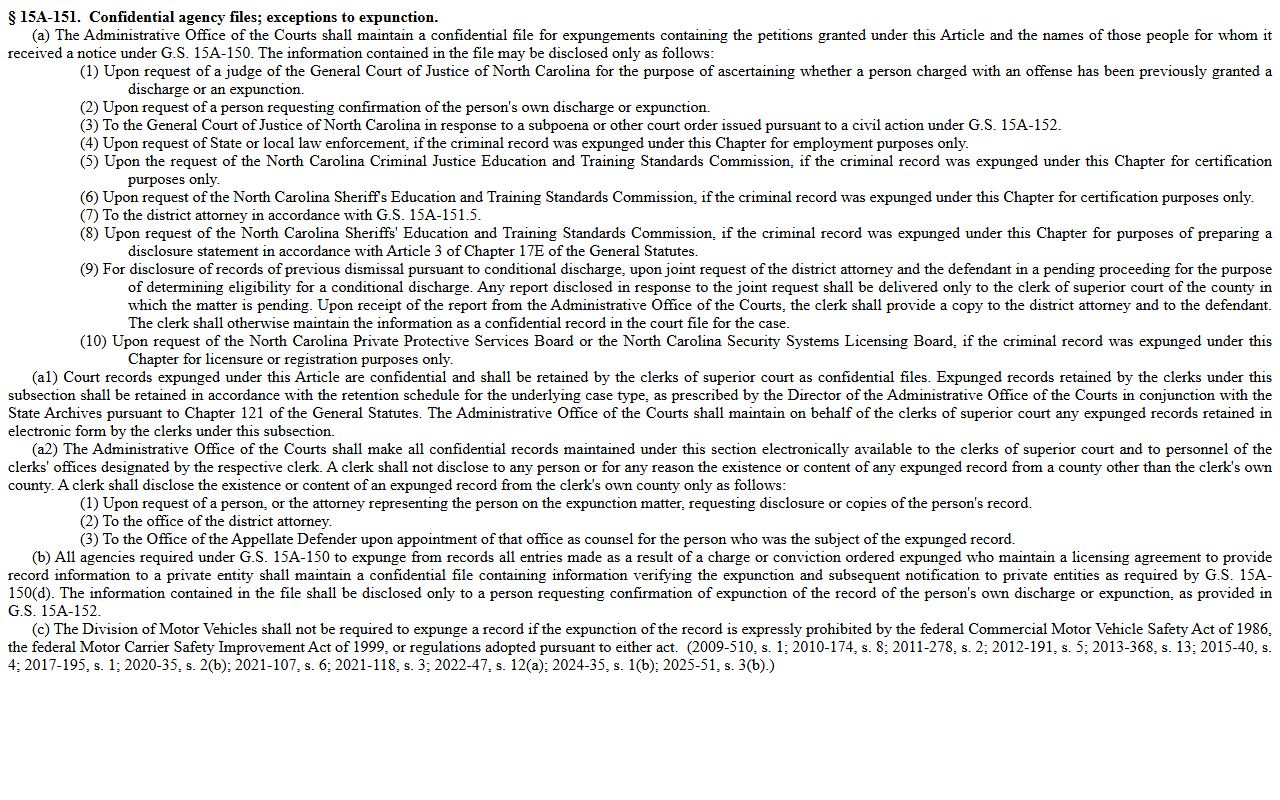
Because expunction can remove eligible records of arrest, charge, and conviction from public view, an online search may not reflect confidential clerk files.
Access Guilford County Criminal Court Records
Guilford County criminal court records are generally available when they are filed public court records and no statute or order restricts them. G.S. 7A-109 is the direct court-record statute for clerk records, files, dockets, and indexes. Broader North Carolina public-records law under G.S. 132-1 applies to public agency records, but filed court records and Sheriff's investigative records have different routes and limits.
Important: Public criminal court records cannot be used for FCRA-regulated screening from this privately operated site.
For clerk access, use the Greensboro or High Point Clerk of Superior Court counters. For the prosecutorial role, Guilford County's District Attorney is Avery Crump in Prosecutorial District 24, with official DA contacts in Greensboro and High Point. The DA prosecutes criminal cases filed in the district, prepares the criminal trial docket, and represents the State in criminal and some juvenile matters.