
Search Guilford County Court Records Online
The first online access point for Guilford County court records is the North Carolina eCourts Portal. Guilford County does not run a separate county-built case search for Superior Court or District Court files. The state portal provides Smart Search for public case information, Search Hearings for court dates, Make Payments for eligible probation, parole, criminal, and infraction matters, and Judgment Search for the judgment index. Public users may search anonymously, but the portal requires JavaScript and cookies and uses a CAPTCHA about every ten minutes.
The Portal Smart Search works best when the user has a case number, a party name, or enough date and location detail to narrow the results to Guilford County. Registration is not required for ordinary public searches, and registration alone does not unlock sealed or restricted case types. When a search is for a certified criminal background check, paper pleadings, or a file that is not fully online, the route changes to the Clerk of Superior Court.
- Open Smart Search in the North Carolina eCourts Portal and choose the general search or advanced filtering tools.
- Enter a case number, business name, or person name in last, first middle suffix format.
- Use the location filter for Guilford County when the result set is too broad.
- Open the matching case summary and review events, parties, hearings, dispositions, and financial information.
- Contact the Clerk of Superior Court when a certified copy, paper file, or certified criminal record search is needed.
The Judicial Branch obtaining court records guidance is the key state reference for case-file access. Its guidance points users back to the clerk in the county where the case is located for criminal, civil, special proceeding, estates, divorce, and paper court records.
The official court-records access page is reflected in the image below.
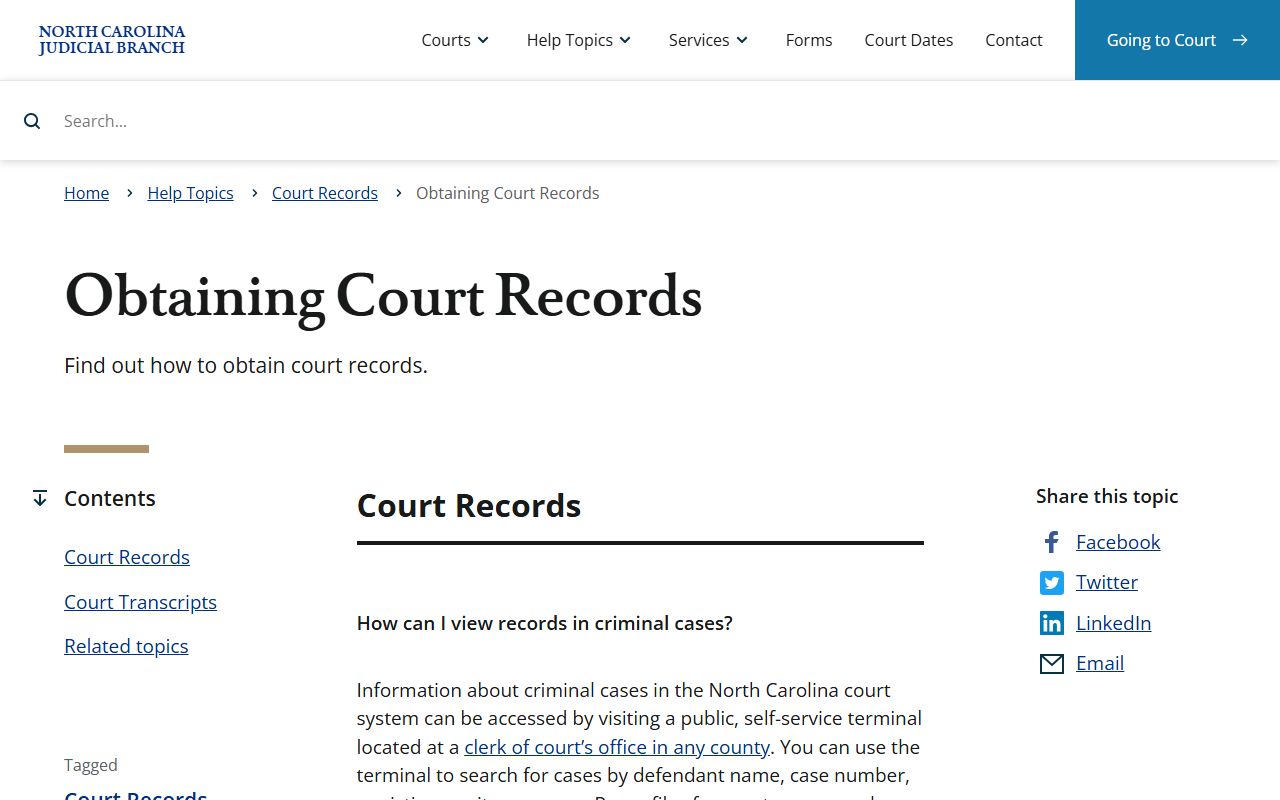
That state guidance matters in Guilford County because the online portal and the clerk counter serve different needs: one is a lookup tool, and the other is the record custodian for copies and files.
Guilford County Court Records Search Fields
Smart Search has enough visible field structure to plan a precise Guilford County court records lookup before submitting a search. Name searches support wildcard rules. A case-number wildcard needs at least four characters. A person-name wildcard needs at least three last-name characters plus an asterisk and at least one first-name character plus an asterisk. For business names, the portal instructs users to choose Business Name in Advanced Filtering Options, type the business name, and replace a comma with an asterisk if the business name includes one.
| Field Label | Type | Required | Notes / Format |
|---|---|---|---|
| Record Number or Name | Text | Required if using main search | Enter record number or party name; case-number wildcard requires at least four characters. |
| Last Name | Text | Required for person search | Wildcard requires at least three characters plus an asterisk. |
| First Name | Text | Required for person search | Wildcard requires at least one character plus an asterisk. |
| Filter by Location | Dropdown / multi-select | Optional | Use Guilford County or All Locations. |
| Filter by Search Type | Dropdown | Unspecified | Party Name, Nickname, Business Name, and Sounds Like are visible. |
| Date of Birth From / To | Date | Optional | Useful for separating common names when public. |
| Case Type, Case Status, File Date | Dropdown / date | Optional | Advanced filters narrow civil, criminal, family, and other case groups. |
Types of Guilford County Court Records
Guilford County court records come from Superior Court, District Court, magistrate matters, and clerk-supervised proceedings. North Carolina has no separate city or county trial court outside the state Judicial Branch structure. Superior Court in Guilford County handles felonies, civil cases over $25,000, and appeals from District Court. District Court handles misdemeanors, infractions, civil cases under $25,000, divorce, custody, child support, juvenile matters, and magistrate matters.
Record type affects both where the file starts and what the public can see. A civil case may show plaintiff, defendant, motions, orders, hearings, and judgments. A criminal case may show charges, hearings, pleas, dispositions, sentence, fines, costs, and probation. Estates and special proceedings may include wills, inventories, fiduciary letters, guardianship petitions, foreclosures, name changes, and other clerk-supervised matters. Arrest and jail records from the Sheriff's Office are related records, but they are not the full court case file.
- Civil court records cover contract, tort, property, domestic, small claims, eviction, and judgment matters.
- Criminal court records cover charges, first appearances, pleas, motions, hearings, verdicts, dispositions, and sentencing.
- Traffic court records are usually infractions or criminal traffic matters, with IF and CR case-number clues.
- Family court records include divorce, custody, support, alimony, protective orders, and some restricted juvenile matters.
- Estates and special proceedings are handled by the Clerk of Superior Court and may include probate and guardianship files.
What Guilford County Court Records Show
Portal case summaries may include case information, assignment information, party information, causes of action, events, dispositions, hearings, and financial items. Criminal case numbers are especially useful in North Carolina. The last two digits of the year charged appear first. If the next two characters are CR, the case includes at least one criminal offense. If the next two characters are IF, the person was charged only with infractions. A single person can have both criminal and infraction charges in related cases.
| Field | What It Shows |
|---|---|
| Case Number | The court file identifier, often showing year and case type clues such as CR or IF. |
| Filing or Offense Date | The date the case began or, in criminal matters, the date tied to the charged offense. |
| Parties | Names of plaintiffs, defendants, petitioners, respondents, defendants, attorneys, or fiduciaries where public. |
| Events and Hearings | The docket history, hearing dates, continuances, motions, orders, and court appearances. |
| Disposition | The outcome of a case, claim, or charge, such as judgment, dismissal, guilty plea, or other result. |
| Financial Information | Costs, fines, fees, judgments, probation amounts, or other money items when shown publicly. |
The certified criminal background check process is separate from casual portal review. The Judicial Branch states that background checks should be requested through the county clerk's office, not by relying only on Portal results.
The certified criminal-record search source is shown in this official image.
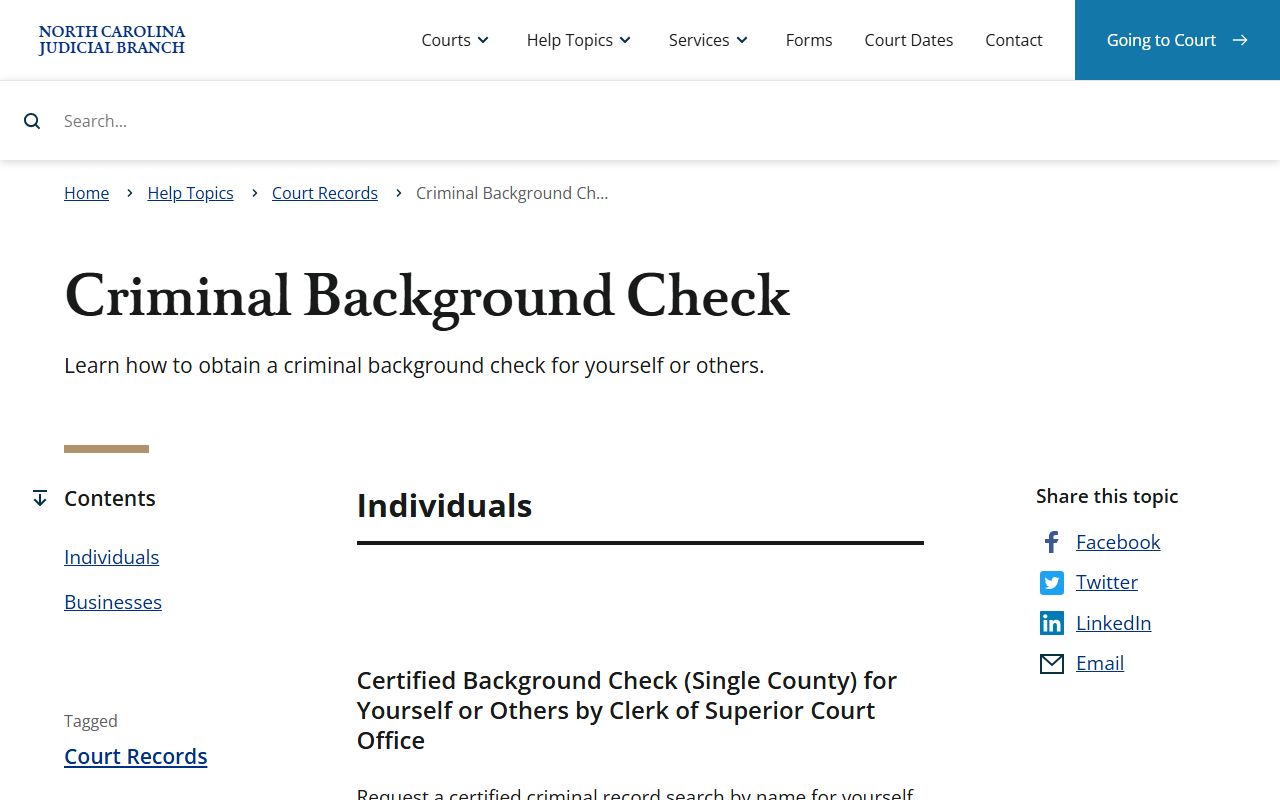
For Guilford County, that means a single-county certified search goes through the Clerk of Superior Court rather than a screenshot or printout from Smart Search.
Public Access for Guilford County Court Records
Guilford County court records are governed most directly by G.S. 7A-109, which says clerks maintain court records, files, dockets, and indexes and that those records are open to public inspection during regular office hours unless law says otherwise. North Carolina's broader public-records law also matters. G.S. 132-1 defines public records for state and local agencies, while G.S. 132-6 addresses inspection and copies.
Case files, county agency records, and law enforcement investigative records do not use the same access path. Filed court cases route to Portal, clerk terminals, and the Clerk of Superior Court. Non-case Judicial Branch public records can use the Judicial Branch public-record request page. County agency records, including many non-court Sheriff's Office records, can route through Guilford County NextRequest. Criminal investigation records have special limits under G.S. 132-1.4.
Note: Portal access is not the same as certified access, and restricted case types remain restricted after registration.
The Judicial Branch public-record request route appears in this source image.
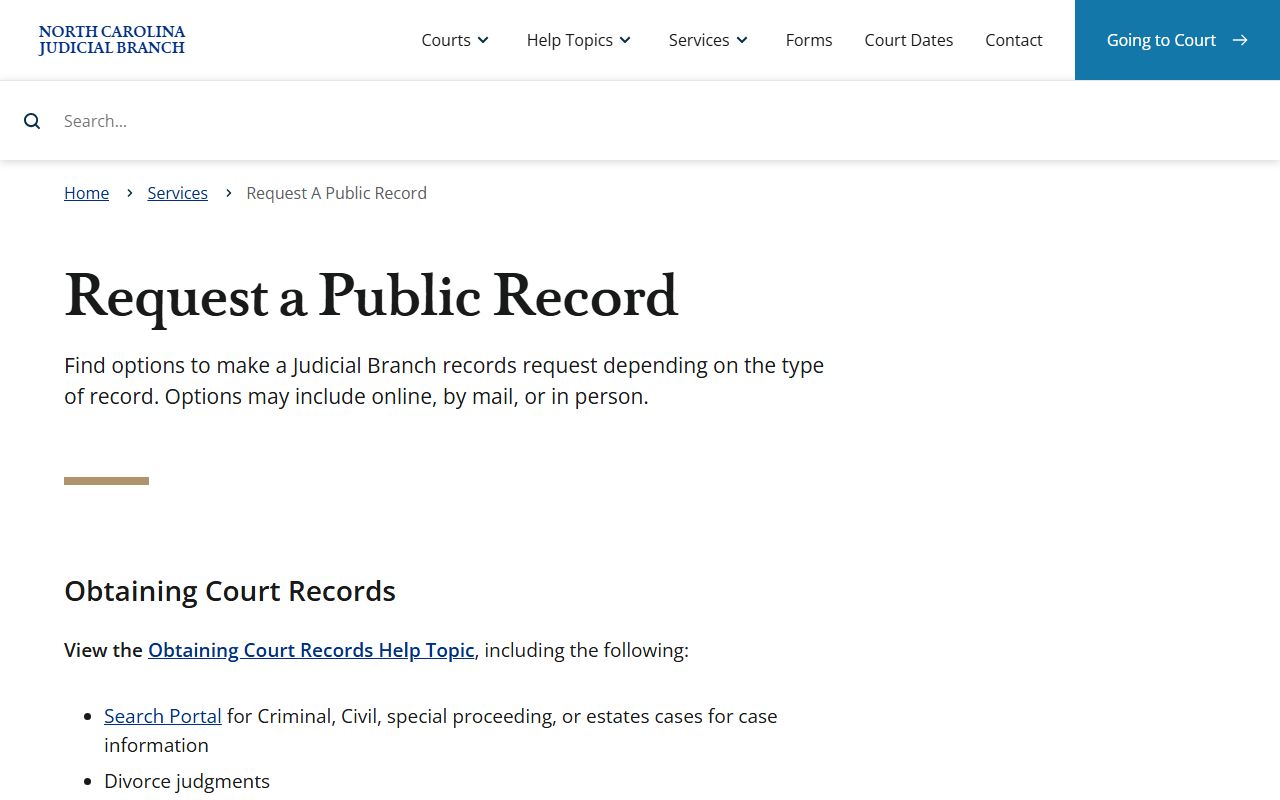
Use that request route for non-case Judicial Branch records, while case documents still belong with the county clerk where the file is located.
Restricted Guilford County Court Records
Some Guilford County court records are not open for ordinary public inspection. Juvenile delinquency and undisciplined records are restricted under G.S. 7B-3000. Juvenile abuse, neglect, and dependency records are withheld from public inspection under G.S. 7B-2901 except as law or court order permits. Adoption records are sealed under G.S. 48-9-102. Mental-health commitment records are confidential under Chapter 122C provisions.
Expunged records are also confidential. G.S. 15A-151 treats expunged court records as confidential clerk files. A public portal search may not show the removed material, and clerk staff cannot release restricted content just because a person asks for it at the counter. When access is legally possible, it usually requires a statute, a party status, or a court order.
The statewide public-records definition source is shown in this image from the North Carolina General Statutes.
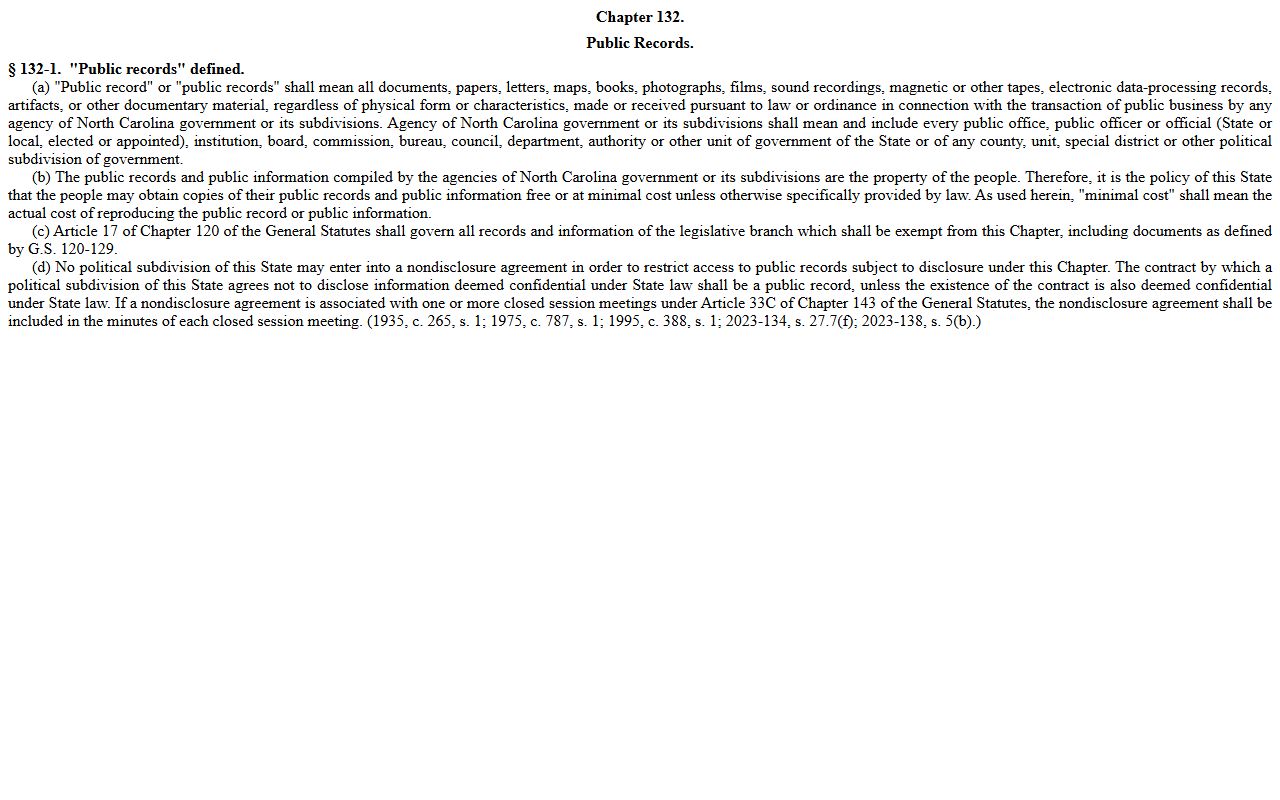
That broad public-records rule sits beside specific court-record restrictions, so each Guilford County file still has to be checked by record type.
Guilford County Court Records at the Clerk
The Clerk of Superior Court is the unified trial-court clerk for Guilford County Superior Court and District Court records. Public self-service terminals can be used for criminal, civil, special proceeding, and estates information. Criminal terminals can search by defendant name, case number, or victim and witness name. Paper files, certified copies, and certified criminal searches are handled through the clerk office where the case is located.
Both courthouse counters are open Monday through Friday from 8:30 a.m. to 12:45 p.m. and 1:45 p.m. to 5:00 p.m. Both locations also have secure drop boxes available 24 hours a day, seven days a week. The ordinary certified single-county criminal record search uses form AOC-CR-314 and costs $25. Guilford County payment information says mail payments must be by money order or certified check, payable to Guilford County Clerk of Superior Court, with no cash or personal checks by mail.
Clerk of Superior Court
201 South Eugene St.
Greensboro, NC 27401
336-412-7300
Monday-Friday, 8:30 a.m.-12:45 p.m. and 1:45-5 p.m.
Clerk of Superior Court
505 East Green Drive
High Point, NC 27262
336-822-6700
Monday-Friday, 8:30 a.m.-12:45 p.m. and 1:45-5 p.m.